























CONTENTS
Depending on how new you are to the world of sustainable fashion, you may or may not have seen GOTS and OEKO-TEX Standard 100 mentioned everywhere. One brand tells you GOTS is the gold standard. Another highlights OEKO-TEX. Some products carry both. And there are lots of influencers on Instagram ranking the two.
As the brand owner of a company that carries both, I believe each of these certifications have their own focus and cover different concerns that parents need to be aware of. In short:
GOTS asks one question: How was this piece of clothing made throughout it’s lifecycle?
OEKO-TEX Standard 100 asks another: Is the finished product safe to wear?
One looks at the full manufacturing process. The other looks at the finished garment.
What GOTS Certifies
 One of the biggest misconceptions about GOTS is that it's simply an organic cotton certification covering the fabric only. And yes, after mentioning GOTS, organic cotton is usually the first thing brands mention. It's also the easiest thing to put on a swing tag.
In reality, organic cotton is just the starting point of this standard.
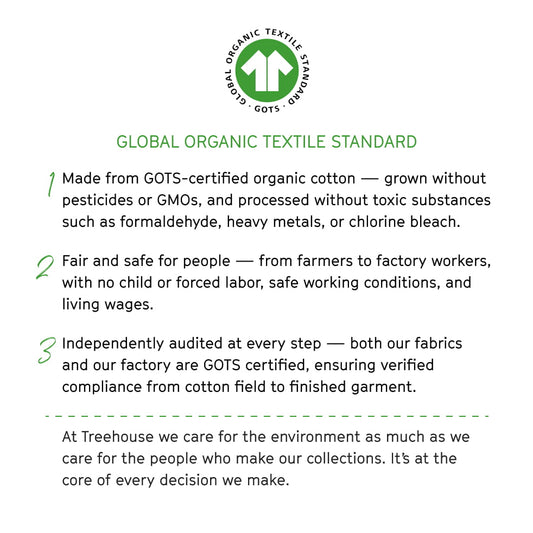
GOTS, short for the Global Organic Textile Standard, is a certification for the entire textile manufacturing process. It follows a garment from the cotton field to the finished product sitting on a store shelf. That means it looks at the raw fiber, the spinning mill, the knitting or weaving, the dye house, the sewing factory, the packaging, and even parts of the social and environmental standards inside those facilities.
In other words, GOTS isn't just asking whether the cotton plant was grown organically, but it's asking whether the entire journey met a defined set of environmental and social requirements.
That's why focusing only on whether the cotton itself is organic tells you very, very little about the finished garment. For example, a conventionally processed organic cotton T-shirt can go through dozens of chemical treatments before it reaches the store.
GOTS was created because the industry needed a standard that looked beyond the farm.
To carry the "organic" GOTS label, a finished textile must contain at least 95% certified organic fibers. Products labeled "made with organic materials" must contain at least 70% certified organic fibers. Both categories follow the same manufacturing rules. The only difference is the percentage of certified organic fiber in the final product.
I've seen parents assume that a product labeled "made with organic materials" follows a weaker environmental standard but it actually does not.
The processing rules, chemical restrictions, wastewater requirements, and social criteria remain the same. The label simply reflects that the finished product contains between 70% and 95% certified organic fibers instead of at least 95%.
The chemical requirements are where GOTS becomes particularly interesting.
You might have read my articles on formaldehyde, PFAS, or flame retardants. If so, you'll know that many of the chemicals found in clothing aren't added during farming.
They're added during manufacturing.
GOTS tackles this problem by maintaining what's known as a positive list of approved chemical inputs. Rather than allowing manufacturers to use almost anything unless it's later detected in the finished garment, only approved dyes, auxiliaries, and processing chemicals may be used during production. Some substances are prohibited entirely, while others are subject to strict residue limits or additional requirements.
👉 For more information: What Is GOTS Certification?
What OEKO-TEX Standard 100 Certifies
 Unlike GOTS, which follows how a textile is produced, OEKO-TEX Standard 100 looks at the finished product itself. Every certified garment is laboratory tested to check whether it contains harmful levels of substances that could come into contact with your skin.
Importantly, the testing isn't limited to the fabric. Every component of the finished product is assessed, including the sewing thread, buttons, zippers, elastics, prints and labels. A garment only receives certification if every part meets the required limits.
One of the biggest differences is that OEKO-TEX can be applied to almost any fibre. A product made from organic cotton, conventional cotton, linen, wool, polyester or blended fabrics can all achieve OEKO-TEX Standard 100 certification because the standard evaluates the finished article rather than how the fibre was grown.
The standard also uses different Product Classes depending on how much skin contact an item is expected to have:
-
Product Class I – Babies and toddlers up to 36 months (the strictest limits)
-
Product Class II – Clothing worn directly against the skin
-
Product Class III – Products with limited skin contact, such as jackets
-
Product Class IV – Decorative textiles with little or no skin contact, such as curtains
As you would expect, the greater the expected skin contact, the stricter the chemical limits become.
The list of substances is updated every year as scientific knowledge evolves. Today, OEKO-TEX Standard 100 screens for more than 1,000 substances, including formaldehyde, certain azo dyes that can release carcinogenic amines, heavy metals, pesticides and many other chemicals of concern. Since January 2024, intentionally added PFAS ("forever chemicals") have also been prohibited under the standard.
Unlike many one-time certifications, OEKO-TEX Standard 100 certificates are valid for only 12 months, meaning manufacturers must renew their certification annually and demonstrate continued compliance.
One final point often causes confusion. OEKO-TEX is the organisation, not a single certification. Standard 100 is the chemical safety test for finished products. MADE IN GREEN by OEKO-TEX combines Standard 100 testing with traceability and responsible production requirements, while OEKO-TEX Organic Cotton is a separate standard focused specifically on certified organic cotton. Not every OEKO-TEX label means the same thing, so it's always worth checking exactly which certification a product carries.
Neither approach is inherently better than the other: they're simply solving different problems.
How to Verify a Certification (Don't Just Trust the Logo)
One of the biggest misconceptions in sustainable fashion is that if a logo appears on a hangtag, the product must be certified.
Unfortunately, it isn't that simple.
A certification logo is a claim. The certificate number is proof.
Both GOTS and OEKO-TEX maintain public databases that allow anyone to verify whether a certification is genuine. It takes less than a minute, yet very few shoppers know these databases exist.
For GOTS, look for the license number on the tag. Every certified company is assigned one, and you can enter it into the public database on the GOTS website. The search will tell you whether the certification is valid, who it belongs to, and what products it actually covers.
For OEKO-TEX Standard 100, look for the certificate or test number. Enter it into the Label Check tool on the OEKO-TEX website and you'll be able to confirm whether the certificate is active and what standard it relates to.
It's one of the simplest ways to protect yourself from greenwashing. If a brand can't provide a verifiable license or certificate number, you should ask why.
That doesn't automatically mean the brand is being dishonest. There may be a perfectly reasonable explanation. But if they're making certification a major part of their marketing, they should be able to back it up.
The more transparent a brand is, the easier it becomes to verify what they're saying.
Which Certification Matters More for Babies?
If you're buying clothing for a baby, I genuinely think the strongest combination is GOTS-certified organic cotton together with OEKO-TEX Standard 100 Class I.
Babies are not simply small adults.
Their skin is thinner, their skin barrier is still developing, and compared with their body weight they have a much larger skin surface area than adults. They also spend an astonishing amount of time sleeping, chewing on clothing, sucking sleeves, and generally putting textiles exactly where you wish they wouldn't.
That's why OEKO-TEX Standard 100 Class I exists.
Class I is the strictest product class within the OEKO-TEX system. It's specifically designed for babies and toddlers up to 36 months, with tighter requirements than products intended for older children or adults. It includes stricter limits for substances such as formaldehyde, testing for colorfastness to saliva, and additional requirements intended to reflect how babies actually interact with clothing.
At the same time, GOTS gives you confidence that the cotton itself was grown organically and that the manufacturing process followed strict environmental and social requirements from beginning to end.
One certification answers "How was this made?"
The other answers "Is the finished garment safe to wear?"
For babies, I don't think those are competing questions.
I think they're equally important.
Why We Go Beyond Certification at Treehouse
I'm a big believer in third-party certifications; they're one of the best tools parents have because they replace marketing claims with independent verification.
But I also don't believe a certification should ever be the end of a brand's due diligence.
For my own brand, Treehouse, it's where our due diligence begins.
Over the last several years, I've traveled to India multiple times to visit our manufacturing partners in person. I've walked through spinning mills, knitting facilities, dye houses, sewing factories, and finishing units, all of which are involved in the production of our pieces and form the supply chain. I've watched fabrics being dyed, discussed chemical management with factory teams, reviewed wastewater treatment processes, and spent hours asking questions that don't appear on an audit checklist. I also spend time with the most important people on the ground: the workers. I do it because certifications provide independent snapshots in time, but building relationships gives you context and allows you to understand the ethos of your factory partners.
You learn how a factory approaches problems when an auditor isn't standing beside them. You understand how decisions are made, how quality is maintained, and whether the people making your children's clothes genuinely care about the product they're producing.
I also think it keeps us honest.
It's easy to talk about transparency from the other side of the world.
It's much harder when you've met the people making your clothing, walked through the production floor yourself, and know exactly where your garments come from.
That's the standard I wanted for Treehouse.


