






















CONTENTS
Much has been written recently about children's school uniforms containing "forever chemicals."
And honestly, it’s infuriating. School uniforms worn by millions of kids the world over, manufactured with forever chemicals.
Anger and disbelief are understandable reactions.
PFAS have become one of the biggest public health conversations of the past decade.
PFAS are primarily added to clothing to make fabrics repel water, stains and oil. They are not listed on clothing labels, which means you cannot spot them by reading the fibre content. Instead, you have to read the label carefully.
The good news is that PFAS are concentrated in a relatively small group of functional garments rather than all everyday basics. A wardrobe built around untreated, certified natural fibers avoids most of the issue without requiring you to replace everything your child owns.
By the end of this article, you'll know exactly where PFAS are most likely to hide, why even 100% cotton is not always what it seems, and the quickest way to avoid them altogether.
What are PFAS, and Why are They Put in Clothes?
 PFAS, short for per- and polyfluoroalkyl substances, are a family of more than 10,000 synthetic chemicals designed to repel water, grease and oil.
They are incredibly effective.
Spray water onto a PFAS-treated jacket, and it beads up instead of soaking into the fabric. Spill ketchup on stain-resistant school trousers, and it wipes straight off. That convenience is exactly why the textile industry embraced them.
Unfortunately, it is also why PFAS have become an environmental and public health concern.
These chemicals break down extremely slowly, earning them the nickname "forever chemicals." They have now been detected in rivers, drinking water, wildlife and human blood across the world. Studies have also found PFAS in placentas, breast milk and umbilical cord blood, demonstrating that exposure begins before birth.
Scientists are continuing to study the health effects of individual PFAS compounds, but research has associated certain members of the family with immune suppression, reduced vaccine response in children, thyroid disease, elevated cholesterol, reproductive effects and some cancers. Importantly, not every PFAS behaves identically. Some have been studied for decades, while others are much newer and worryingly, far less understood.
That uncertainty is precisely why many scientists argue exposure should be reduced wherever reasonably possible.
Clothing is only one source among many, alongside drinking water, food packaging, non-stick cookware and household dust. But it is one of the easier sources for parents to control because the chemicals are generally added for convenience rather than necessity.
Where PFAS Hides in a Child's Wardrobe
One of the biggest misconceptions is that PFAS are linked to cheap clothing.
They are not.
But they are often linked to performance claims.
If a garment promises to repel stains, shed water or stay wrinkle-free, there is a much greater chance it has been treated with fluorinated chemistry or another textile finish designed to alter how the fabric behaves.
Research consistently finds the highest concentrations in products marketed for exactly these functions.
Common examples include:
-
Stain-resistant school uniforms
-
Raincoats and waterproof jackets
-
Snow suits
-
Ski gloves and mittens
-
Bibs and feeding products
-
Outdoor trousers
-
"Easy-care" or wrinkle-free clothing
-
Water-resistant stroller covers and accessories
One of the most important studies on this topic was published in Environmental Science & Technology Letters by researchers from the University of Notre Dame, Indiana University, the University of Toronto and the Green Science Policy Institute.
The researchers tested children's textiles from major North American brands and found fluorine, a marker for PFAS treatment, in approximately 65% of samples. Every school uniform marketed as stain-resistant contained measurable PFAS. The most common compound identified was 6:2 fluorotelomer alcohol (6:2 FTOH), one of the short-chain fluorinated compounds that replaced older chemicals such as PFOA in many applications.
Perhaps the most interesting finding was not that PFAS existed.
It was where they existed.
The chemicals were overwhelmingly associated with garments sold on the promise of resisting something. Water. Stains. Dirt. Oil.
That is an important distinction because it gives parents something practical to work with.
A plain cotton T-shirt and a stain-resistant cotton school shirt may both say "100% cotton" on the label, yet they can be chemically very different products.
The Cotton Myth
 One of the most persistent pieces of advice online is simply:
"Buy cotton."
Cotton tells you what the fiber is.
It tells you nothing about what has happened to that fiber after it left the farm.
The Notre Dame study produced one of the most surprising findings in the entire PFAS conversation.
Some 100% cotton school uniforms actually contained higher levels of PFAS than polyester blends.
That sounds backwards until you understand textile finishing.
Cotton naturally absorbs water.
If a manufacturer wants cotton to suddenly repel muddy puddles, tomato sauce and juice boxes, it has to change the chemistry of the fabric. Historically, PFAS have been one of the cheapest and most effective ways of doing exactly that.
Polyester, on the other hand, already resists water more readily than cotton, meaning it often requires less additional treatment to achieve the same marketing claim.
This is why shopping by fiber alone is not enough.
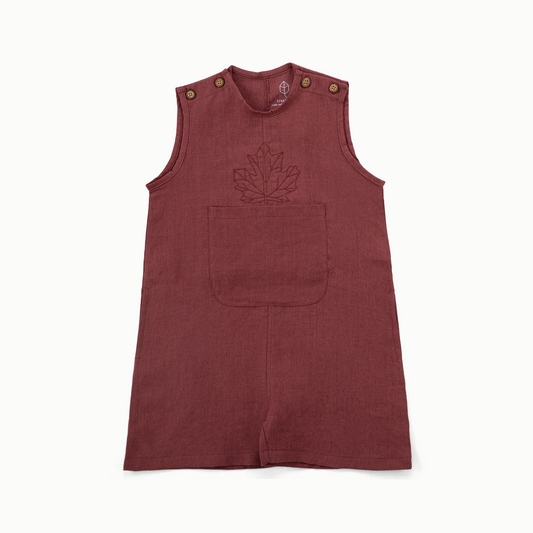
A plain organic cotton T-shirt, untreated linen romper, or everyday pair of cotton pants has very little reason to carry PFAS.
A cotton school uniform advertised as stain-resistant is a completely different product.
The finish matters more than the fiber.
That single idea is probably the most useful thing a parent can remember.
How to Spot PFAS When They Are Not Listed on the Label
Unlike food, clothing does not come with an ingredient list.
There is no legal requirement for brands to declare whether PFAS have been used during textile finishing.
Instead, parents have to become fluent in marketing language.
If you see claims such as these, pause before buying:
-
Stain-resistant
-
Stain-proof
-
Stain-release
-
Water-resistant
-
Water-repellent
-
Durable Water Repellent (DWR)
-
Wrinkle-free
-
No-iron
-
Easy-care
-
Soil-release
-
Oil-resistant
You should also take a closer look at garments marketed under well-known performance coatings such as Teflon™ or Scotchgard™.
That said, this is where nuance matters.
Not every modern version of these branded finishes still relies on fluorinated chemistry. Several manufacturers have reformulated products in response to regulatory changes and consumer pressure. The brand name alone is no longer enough to tell you what chemistry sits behind it.
Likewise, not every raincoat contains PFAS, and not every water-repellent finish is fluorinated.
This is why parents need a second layer of verification.
Fortunately, there is one that is considerably more reliable than marketing claims alone.
Do Not Be Fooled by "PFOA-Free" or "PFC-Free"
Once brands realised consumers were becoming concerned about PFAS, the marketing changed.
You started seeing labels that said things like "PFOA-free", "PFC-free" or "C8-free."
Those claims sound reassuring, but they often tell only a small part of the story.
PFOA is just one member of the PFAS family. It has largely been phased out because of mounting evidence linking it to human health and environmental concerns. Many manufacturers replaced it with newer short-chain fluorinated compounds that were marketed as safer alternatives but still belong to the broader PFAS family.
The Notre Dame school uniform study illustrates this perfectly. The researchers found that the most abundant PFAS was not PFOA at all. It was 6:2 fluorotelomer alcohol (6:2 FTOH), one of the replacement chemicals now commonly used in textile treatments.
In other words, removing one chemical does not necessarily remove the entire class.
Think of it like saying a food is "peanut-free" when it still contains tree nuts. Technically accurate, but potentially misleading if you thought it meant free from all allergens.
The better question is not whether a garment is free from one particular PFAS.
It is whether intentionally added PFAS have been avoided altogether.
The Reliable Shortcut: Certifications That Actually Tell You Something
The difficulty with PFAS is that brands are rarely required to disclose them.
That means parents often end up relying on marketing claims instead of independent evidence.
This is where certifications become genuinely useful.
GOTS
The Global Organic Textile Standard (GOTS) is much more than an organic cotton certification.
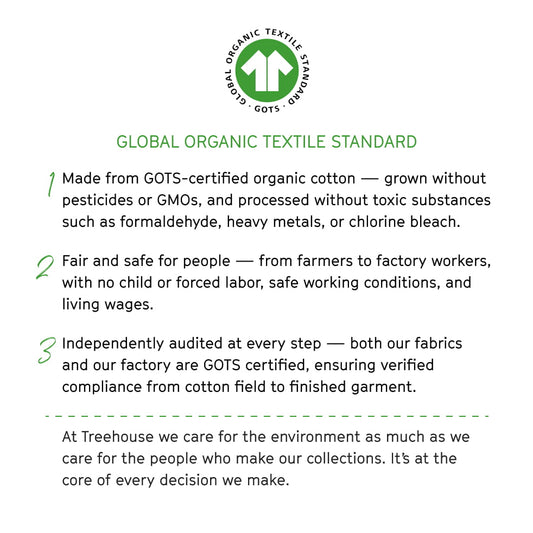
It covers the entire manufacturing process, from spinning and dyeing through to printing and finishing. Importantly, GOTS prohibits the intentional use of PFAS throughout certified textile production, alongside hundreds of other chemicals commonly used in conventional manufacturing.
It also requires certified organic fibers, strict wastewater controls and independent auditing throughout the supply chain.
That makes it one of the strongest certifications available for parents trying to reduce unnecessary chemical exposure.
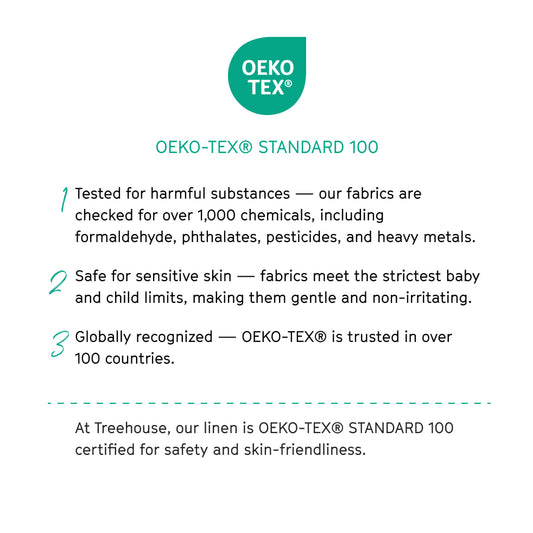
OEKO-TEX Standard 100
OEKO-TEX Standard 100 approaches the problem differently.
Rather than prescribing every chemical used during manufacturing, it tests the finished product itself for hundreds of substances known or suspected to be harmful to human health.
Since January 2024, OEKO-TEX has prohibited the intentional use of PFAS within Standard 100 certification and introduced total fluorine testing to strengthen compliance.
For babies and young children, look for Product Class I, the strictest category within the standard.
One step almost nobody talks about is verification.
Both GOTS and OEKO-TEX issue licence or certificate numbers that can be checked on their public databases in under a minute.
You do not have to take a brand's word for it.
If a company claims certification but does not provide a certificate number, ask for it.
Transparent brands will usually be happy to share it.
One important point is worth mentioning because it causes enormous confusion.
Organic cotton is not automatically the same as GOTS-certified organic cotton.
A garment can be made from organically grown cotton yet still undergo conventional dyeing, finishing, or chemical treatments later in the manufacturing process.
Certification covers the whole journey.
The fibre alone does not.
The Law Is Finally Catching Up
For years, regulation struggled to keep pace with the science.
That is beginning to change.
As of 1 January 2025, both California and New York prohibit the sale of apparel containing intentionally added PFAS.
California's Safer Clothes and Textiles Act (AB 1817) goes even further. Beginning in 2027, apparel sold in the state must also contain less than 50 parts per million of total organic fluorine, making the legislation one of the strictest in the world.
There is one important exception.
Certain outdoor clothing designed for severe wet conditions has been given a temporary exemption until 2028, recognising that finding equally effective alternatives for extreme technical gear has proved more challenging.
Even then, manufacturers must disclose the use of PFAS.
If you buy qualifying outdoor gear, you may now see a label stating:
"Made with PFAS chemicals."
Ironically, this is one of the very few situations where a clothing label actually tells you PFAS are present.
The practical impact extends well beyond California and New York.
Together, they represent enormous clothing markets. Rather than manufacture different products for different states, many brands are reformulating their collections nationally.
Parents are already beginning to benefit from that shift.
The Calm Way to Lower PFAS in Your Child's Wardrobe
The goal is not perfection.
It is reducing exposure where it is easy to do so.
If I were starting from scratch today, this is exactly what I would do.
-
Choose plain everyday basics made from natural fibers rather than garments marketed for special performance.
-
Be cautious of claims such as stain-resistant, water-repellent, wrinkle-free and easy-care unless the product clearly explains how those properties have been achieved.
-
Look for GOTS-certified organic cotton or OEKO-TEX Standard 100 certification rather than relying on marketing language.
-
Verify certificate numbers instead of assuming certification claims are genuine.
-
For rainwear and snow gear, where water repellency genuinely serves an important purpose, look for brands that explicitly state they use PFAS-free finishes.
Most importantly, do not feel you need to replace everything overnight.
PFAS are one source of exposure among many. The biggest gains usually come from making better choices, as clothing naturally needs replacing.
👉 Shop our organic cotton kids' clothes and organic cotton baby clothes.
Why Treehouse Chooses Certification
One of the reasons I spent years researching textile supply chains before launching Treehouse was that I became frustrated by how difficult it was for parents to answer what should have been simple questions.
What chemicals are on this fabric?
Can I trust this certification?
Is "organic" actually meaningful?
Rather than asking parents to decode dozens of performance claims, we decided to build our collections differently.
Our clothing is made using GOTS-certified organic cotton and OEKO-TEX Standard 100 certified linen, two certifications that prohibit intentionally added PFAS within their standards.
We also avoid the very features that often drive PFAS use in the first place.
You will not find stain-proof coatings, water-repellent treatments, or chemical performance finishes on our everyday basics because they simply are not necessary.
Children's clothes can be practical without becoming miniature pieces of outdoor equipment.
We focus instead on durable construction, heavier-weight fabrics, flat seams, tag-free designs and natural fibers that are comfortable enough to wear all day without relying on chemical finishes to create their selling point.


