

























CONTENTS
As a parent (especially one on Instagram perusing the non-toxic momfluencers), you see the following:
Everyone claims to be “organic.”
Organic cotton pajamas. Organic cotton baby clothes. Organic cotton basics.
But here is what most brands do not explain:
Not all organic cotton is created equal.
Yes, organic cotton can be a significantly more sustainable alternative to conventional cotton. But simply seeing the word “organic” on a label does not automatically mean a garment is truly sustainable, responsibly made, or free from harmful chemical processing.
That distinction matters.
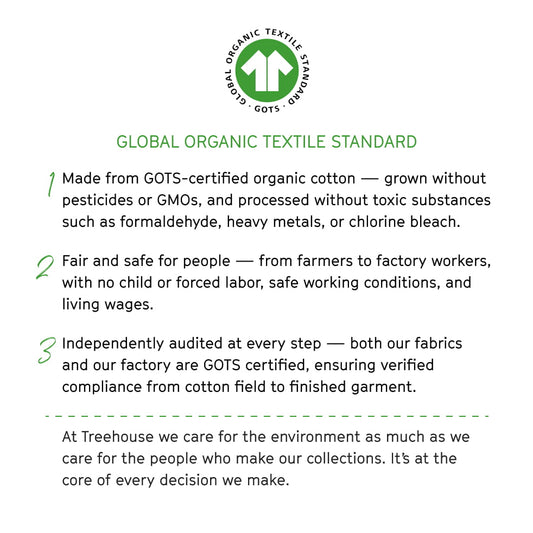
Because while organic cotton farming is a huge step in the right direction, the gold standard is GOTS-certified organic cotton, which verifies not just how the cotton was grown, but how it was processed, dyed, and manufactured all the way through the supply chain.
In this guide, we will break down:
-
Whether organic cotton is actually sustainable
-
How it compares to conventional cotton
-
Why GOTS-certified organic cotton matters far more than generic “organic cotton” claims
-
What this means for your child’s wardrobe

What Does “Organic Cotton” Actually Mean?
Organic cotton refers to cotton grown without:
-
Synthetic pesticides
-
Synthetic herbicides
-
Genetically modified seeds
-
Synthetic fertilizers
Organic farming methods also prioritize:
-
Soil regeneration
-
Biodiversity
-
Water conservation
-
Natural pest management
That is all positive.
However, here is the critical nuance many brands leave out:
“Organic cotton” only describes how the cotton was grown.
It says nothing about:
-
How the fabric was dyed
-
What finishing chemicals were used
-
Whether toxic processing agents were added later
-
Labor standards in manufacturing
-
Environmental standards in mills and factories
A garment can be made from organically grown cotton and still be processed with harsh dyes, chemical finishes, and poorly regulated manufacturing practices.
That is why GOTS certification matters.
GOTS (Global Organic Textile Standard) verifies the entire textile supply chain, not just the farming stage.
Without that certification, “organic cotton” is often only part of the story.
The True Environmental Impact: Organic vs Conventional Cotton
 Conventional cotton is often referred to as one of the world’s dirtiest crops because of its enormous chemical and water footprint.
When parents ask whether organic cotton is sustainable, what they are really asking is:
Is it meaningfully better than conventional cotton?
The answer is yes.
But again, GOTS-certified organic cotton is the most credible and complete version of that claim.
Saving Water, Drop by Drop
Conventional cotton is one of the most water-intensive crops in global agriculture.
It often relies heavily on aggressive irrigation systems that deplete local groundwater supplies and strain already water-stressed regions.
Organic cotton farming typically uses healthier, more biologically active soil that retains moisture better and relies more heavily on rain-fed agriculture.
This can dramatically reduce water usage compared to conventional cotton production.
According to the Textile Exchange, organic cotton can use significantly less blue water (irrigation water drawn from ground and surface sources) than conventional cotton.
That means choosing organic cotton helps preserve one of our most precious natural resources.
And choosing GOTS-certified organic cotton provides far greater confidence that those sustainability claims have actually been verified across production.
Protecting Soil and Eliminating Toxic Chemicals
Conventional cotton farming uses enormous quantities of synthetic pesticides and fertilizers.
Those chemicals can:
-
Pollute waterways
-
Damage local ecosystems
-
Harm biodiversity
-
Exposes farmers and nearby communities to hazardous substances
Organic cotton farming prohibits these synthetic chemicals.
Instead, farmers use natural methods such as:
-
Crop rotation
-
Companion planting
-
Beneficial insects
-
Compost and natural fertilizers
Healthy organic soil also acts as a carbon sink, meaning it can store carbon from the atmosphere rather than releasing it.
That makes regenerative organic farming an important part of the climate conversation.
But again, if cotton is only grown organically and then chemically processed later, some of that environmental benefit is undermined.
That is why GOTS-certified organic cotton remains the benchmark for truly sustainable textiles.
Organic Cotton vs Conventional Cotton at a Glance
| Sustainability Factor | Conventional Cotton | Organic Cotton | GOTS-Certified Organic Cotton |
|---|---|---|---|
| Farming Chemicals | Heavy synthetic pesticide/fertilizer use | No synthetic pesticides/fertilizers | No synthetic pesticides/fertilizers |
| Water Usage | High irrigation dependence | Typically lower, more rain-fed | Typically lower, more rain-fed |
| Soil Health | Often degrades soil over time | Supports healthier soil biology | Supports healthier soil biology |
| Dye/Processing Controls | No restrictions | No restrictions | Strictly regulated |
| Supply Chain Transparency | Minimal | Minimal | Full certification required |
| Worker Protections | Varies widely | Low | Enforced standards required |
👉 More in the Organic Cotton vs. Regular Cotton article.
Why Sustainability Matters for Your Baby’s Wardrobe

Sustainability is not just about the planet.
It also affects what touches your child’s skin every day.
Babies and young children have:
-
More permeable skin than adults
-
Higher surface area relative to body size
-
Greater vulnerability to irritants and sensitizers
Organic cotton grown without toxic agricultural chemicals is already a better starting point.
But if that cotton is later dyed or finished using harsh chemical treatments, much of that advantage can be lost.
That is why GOTS-certified organic cotton is the safer standard for baby and kids’ clothing.
GOTS certification restricts and prohibits a wide range of potentially harmful substances during textile processing, including many problematic dyes, finishes, and auxiliaries.
It is one of the strongest indicators that a garment was made with both environmental and human health in mind.
If you are looking for truly safer basics for sensitive skin, eczema-prone children, or newborns, certification matters.
👉 Explore our organic cotton baby clothes.


